
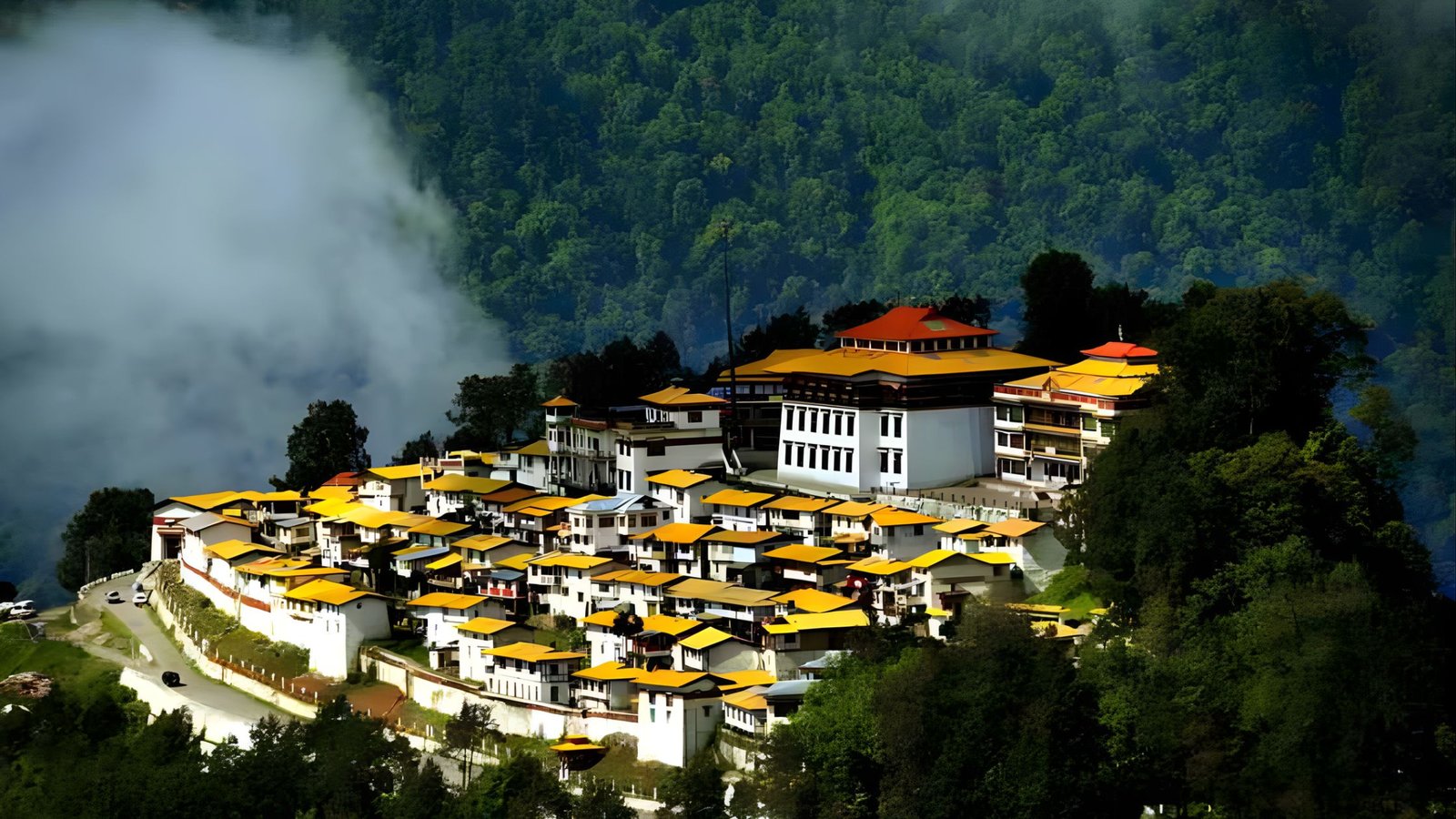
The drive from Agartala to Udaipur takes about an hour and a half. The road runs south through a landscape that shifts between paddy fields, rubber plantations, and low forested hills. Tripura is India's third smallest state, and there's a compactness to it that larger states don't have: everything feels close, connected, and unhurried. You get the sense, somewhere around the halfway point, that you're travelling not just through distance but through time.
Udaipur sits in the Gomati district, roughly 55 kilometres from the state capital. It carries its own quiet identity, built around temples, water, and a history that stretches back further than most Indian cities publicly acknowledge. The temple is 3 kilometres from Udaipur town. Auto-rickshaws cover the distance in minutes.
Before you even reach the entrance gate, the land itself tells you something is different here. The Tripura Sundari Temple, known popularly as Matabari, sits atop a small hillock whose silhouette bears a distinct resemblance to the arched back of a tortoise. In Sanskrit, this form is called Kurma Prishthakrti. In Hindu cosmology, the tortoise (kurma) is Vishnu's second avatar, the creature that held up the weight of creation on its back. A Shakti temple built on tortoise-shaped earth carries a symbolism so deliberate, so layered, that the ground itself becomes part of the sacred meaning.
This is why Matabari carries the title of Kurma Pitha, the tortoise throne. You are, quite literally, standing on the back of the universe.
The temple's exterior reflects the same intentionality. Built in the Bengali chala style called Ek-ratna, it features a square sanctum rising to roughly 75 feet, topped with a conical dome, finished in red and white. There is no excessive ornamentation. What the structure communicates instead is age and certainty, the kind that only 524 unbroken years of worship can give a building.
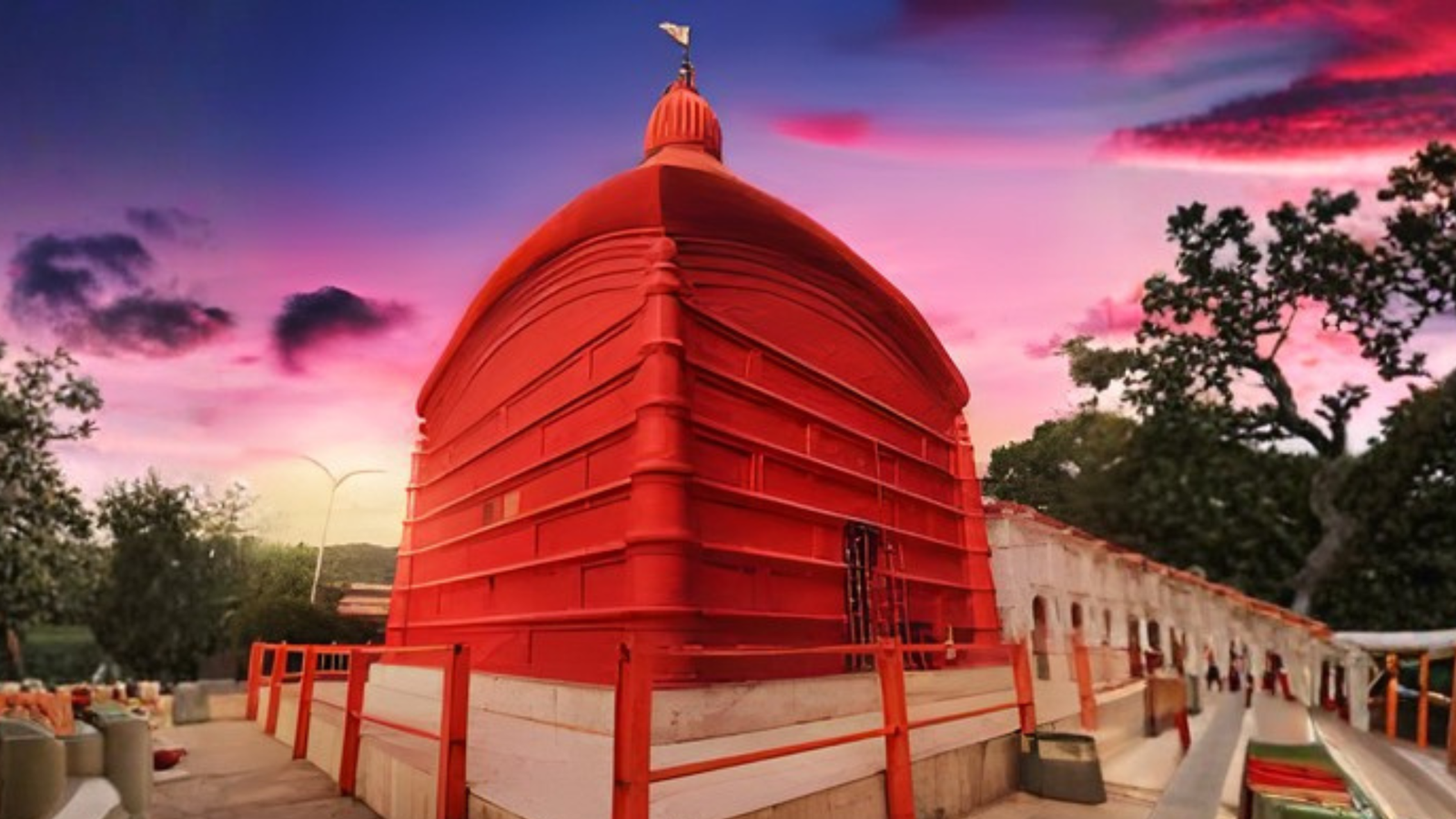
Maharaja Dhanya Manikya of the Manikya dynasty built this temple in 1501 CE. That date matters. It predates the Mughal Empire. It predates the first European trading posts in India. It predates much of what textbooks consider the "beginning" of Indian history as most people know it.
The story behind its construction is one that locals recount with a particular quiet pride. The king received a divine vision in which Goddess Tripura Sundari appeared and directed him to establish her worship on a hillock near Udaipur. The complication: the hill already housed a Vaishnava temple dedicated to Vishnu. A theological problem with no clean solution. The goddess returned the following night. Her message was simple: they are not separate. In 1501, the king built the temple.
The goddess enshrined here, Tripura Sundari, also called Tripureshwari, is the divine figure after whom the entire state of Tripura takes its name. Think about that for a moment: a goddess so central to this land that the land was named after her.
The temple houses two idols. A 5-foot black stone figure of the goddess at the main altar, and a smaller 2-foot idol called Chhoto-Ma, "Little Mother," which the Manikya kings carried into battle as a protective talisman. There is something both fierce and deeply human about that detail, a pocket-sized goddess riding to war in a king's possession, asked not for grandeur but for survival.
Matabari is one of the 51 Shakti Peethas, the holiest Shakti shrines in Hinduism. Each one marks a spot where a part of Goddess Sati's body fell to earth after Lord Vishnu dismembered her to release a grief-consumed Shiva from his eternal, world-destroying dance.
At Matabari, Sati's right foot is believed to have landed.
There are only 51 such sites across the entire Indian subcontinent. Matabari is one of them. That is not a regional claim or a local legend inflated by tourism. It is a position this temple holds in the formal geography of Hindu sacred tradition, documented across ancient texts and recognised by millions of devotees across centuries.
Standing here, you are standing at one of 51 coordinates where mythology and earth intersect. That is a rare thing to be able to say about any piece of ground.
The inner sanctum is small. After the open courtyard, the narrowing of space is immediate and physical. Red hibiscus flowers, the goddess's preferred offering, cover the altar. The air carries incense and the low, steady sound of chanting.
The black stone idol of Tripura Sundari, ancient and unadorned, holds the centre with a presence that resists easy description.
Morning hours offer the most undisturbed experience. The temple opens at 4:00 AM, and the first prayers of the day carry a quality that the afternoon crowds simply cannot replicate.
On the eastern side of the complex lies Kalyan Sagar, a large sacred lake that is as much a part of the Matabari experience as the shrine itself.
The lake is home to a colony of Bostami turtles, a rare freshwater species found in very few places in the world. Here, they are considered sacred. They surface slowly, unbothered, carrying the particular unhurriedness of creatures that have lived in a protected space for generations.
Pilgrims feed them puffed rice from the bank. The turtles come up to meet each handful with a patience that feels almost ceremonial.
Given that Matabari is the Kurma Pitha, the tortoise throne, and that these rare turtles have made their home in its lake, the whole thing takes on a resonance that is hard to shake. The mythology and the ecology are telling the same story.
It is also worth knowing that Matabari banned single-use plastic bags within its premises in 1998, years before Tripura's state-wide legislation followed. A temple that has been ecologically conscious since before it was fashionable to be so.
Outside the complex, small shops sell Matabari Peda, a condensed milk sweet that serves as the temple's official prasad. It is soft, lightly sweet, and so distinctly tied to this place that it recently received a Geographical Indication (GI) tag.
This is the same kind of formal recognition given to Darjeeling tea and Kolkata's Rosogolla. The certification means exactly what it says — you cannot get the real Matabari Peda anywhere except here.
Buy a box near the temple gates. The fresh ones are worth the extra two minutes of walking.
In 2025, Matabari underwent significant redevelopment under the Government of India's PRASHAD Scheme, a programme designed to upgrade nationally important pilgrimage sites across the country.
An investment of over ₹54 crore introduced marble flooring, improved pathways, a meditation hall, upgraded visitor facilities, and a dedicated Matabari gallery that documents the temple’s long history.
Prime Minister Narendra Modi inaugurated the renovations. Despite these upgrades, the temple has retained its traditional atmosphere — the centuries-old stone and sacred environment remain unchanged while visitor accessibility has improved significantly.
The temple’s most important event is the Diwali Mela, a two-week fair when pilgrims arrive from across Tripura, Assam, West Bengal, and Bangladesh.
During the festival the complex is illuminated with oil lamps throughout the night. Rituals continue until dawn, and the normally quiet town of Udaipur transforms into a vibrant spiritual gathering.
If you plan to visit during Diwali, book accommodation early in Udaipur or Agartala as hotels fill up quickly.
For a calmer visit, the months from October to March are ideal — the weather is pleasant and the temple atmosphere is peaceful.
Getting There: Fly to Maharaja Bir Bikram (MBB) Airport in Agartala. The temple is about 55 km from the airport. Pre-booked taxis are the most convenient option. Shared buses also run from Agartala bus stand to Udaipur.
Entry & Timings: Entry to the temple is completely free. The temple is open daily from 4:00 AM to 9:00 PM.
Dress Code: Visitors should keep shoulders and knees covered. Scarves and wraps are available from shops near the entrance.
Recommended Visit Duration: Plan around 2–3 hours to explore the temple and Kalyan Sagar lake. Half a day is ideal if you wish to explore Udaipur town as well.
Neermahal Water Palace: Located about 45 km away on Rudrasagar Lake, this palace combines Mughal and Hindu architectural styles and is best visited during sunset.
Bhuvaneswari Temple: Another Shakti shrine near Udaipur that reflects the region’s deep tradition of goddess worship.
Ujjayanta Palace: A former royal residence in Agartala, now a state museum that tells the story of the Manikya dynasty who built Matabari Temple.
Sepahijala Wildlife Sanctuary: Located 35 km from Agartala, this forest reserve is home to clouded leopards, spectacled monkeys and more than 150 bird species.
Matabari Temple does not rely on spectacle or modern marketing. Instead, it offers over 524 years of uninterrupted worship and spiritual heritage.
As one of only 51 Shakti Peethas in the world, it carries immense cosmological significance. The temple lake shelters rare turtles protected by faith for generations, and the famous Matabari Peda sweet holds a government-recognized Geographical Indication tag.
For travellers exploring Northeast India, Matabari requires only half a day, yet the experience of standing in a living sacred tradition that has endured for centuries makes the visit unforgettable.
