
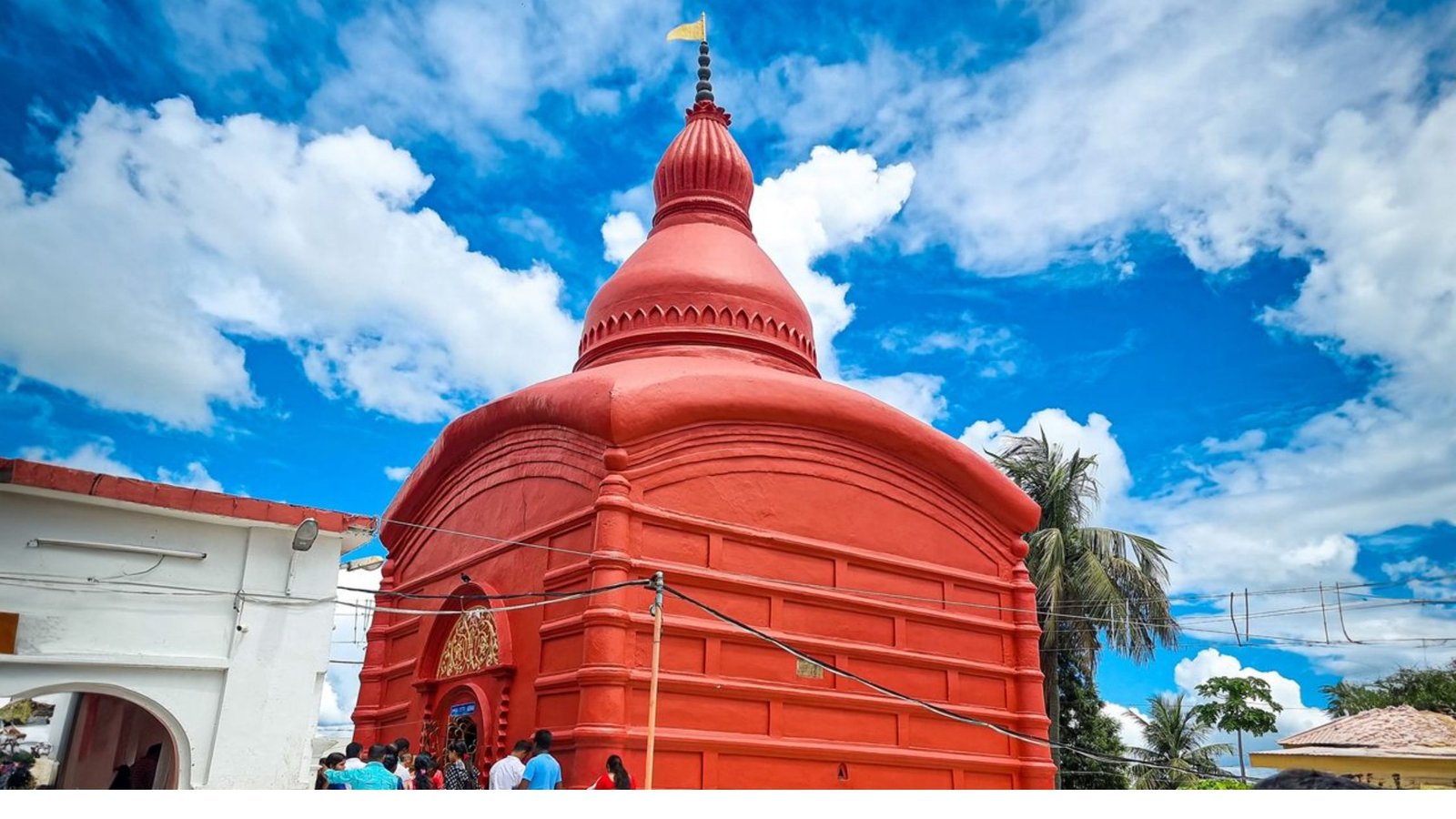
What if a single footstep, not a human one, but a goddess's, could make a piece of earth holy forever? What if a king's dream built a temple that outlasted his entire dynasty? And what if, right now, there is a sacred lake in Northeast India where ancient turtles have been guarding a divine secret for centuries, and almost no one outside the state knows it exists?
The answers are all in one place. And that place has been quietly waiting for you for over 500 years. Somewhere in the quiet hills of Tripura, a goddess has been waiting for over five centuries. Not many know her name. Fewer still have made the journey. But those who have, always come back.
The Tripura Sundari Temple, known locally as Matabari, is a 524-year-old Hindu shrine nestled in the town of Udaipur, Gomati District, Tripura, just 55 kilometres from Agartala. Built in 1501 CE by Maharaja Dhanya Manikya, it is one of the most spiritually significant temples in all of Northeast India, and one of the 51 Shakti Peethas, the holiest cluster of shrines in Hinduism.
The presiding deity, Goddess Tripura Sundari, a form of Parvati and Kali combined, is the very figure after whom the state of Tripura takes its name. The temple houses two sacred idols: a 5-foot black stone idol of Tripura Sundari, and a smaller 2-foot idol known as Chhoto-Ma ("Little Mother"), believed to have accompanied Tripura's kings into battle as a divine protector.
Matabari is not merely a regional temple, it occupies a place in the cosmology of Hinduism itself. According to ancient belief, when Lord Vishnu used his Sudarshana Chakra to sever the body of Goddess Sati into 51 pieces, freeing a grief-stricken Shiva from his eternal lament, Sati's right leg is believed to have fallen at this very hillock in Udaipur. That divine contact transformed the earth here into one of the 51 Shakti Peethas, each a point where the sky once touched the ground.
For Shakti devotees, visiting a Peetha is not merely a pilgrimage. It is a conversation with consecrated earth, made sacred not by human hands, but by cosmic grief.
Every great temple has its founding legend. At Matabari, that legend begins with a dream, and a king's courage to trust it. In the closing years of the 15th century, Maharaja Dhanya Manikya is said to have received a divine vision in which Goddess Tripura Sundari appeared and commanded him to build her a shrine on a hillock near Udaipur. There was just one complication: the hill already housed a Vaishnava temple dedicated to Lord Vishnu. How could a Shakti idol be installed in a site consecrated to Vishnu?
The goddess returned the following night. This time, the king understood, Vishnu and Shakti were not rivals, but two expressions of the same Supreme Being. He set aside theological hesitation, and in 1501 CE, the Tripura Sundari Temple was consecrated.
Locals add another layer to the story: the original idol was not installed by human hands at all. It was found submerged in the waters of a sacred water body called Brahmachhara, waiting, as if it had always been there, for someone with faith enough to look.
To this day, Matabari is regarded as a rare symbol of inter-sectarian harmony, equally venerated by Vaishnavas, Shaivites, and Shaktas alike.
Architecturally, Matabari is a study in intentional design. The temple is built in the Bengali-hut style (chala), locally called the Ek-ratna form, featuring a square sanctum of roughly 24 square feet rising to approximately 75 feet, crowned by a distinctive conical dome.
But the real architectural wonder lies beneath your feet: the hillock on which the temple sits is shaped like the back of a tortoise, a form known in Sanskrit as Kurma Prishthakrti. This is considered among the holiest possible foundations for a Shakti shrine, earning Matabari the additional title of Kurma Pitha, "the throne of the tortoise. "
The temple's red-and-white exterior, framed by the rolling green hills of Udaipur, creates a quietly dramatic silhouette that has remained largely unchanged for over five centuries.
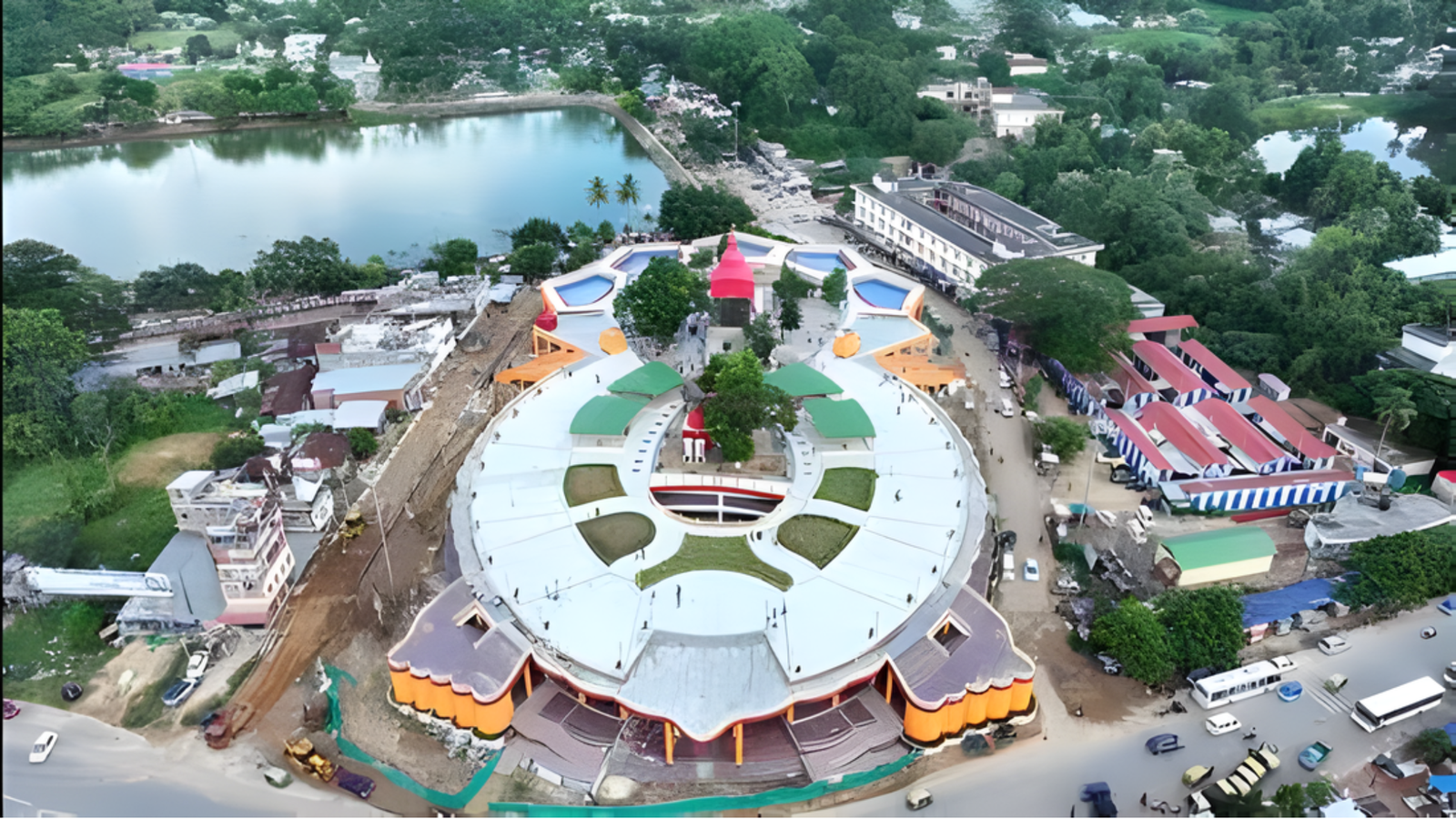
On the eastern side of the temple lies Kalyan Sagar, a large sacred lake that is as much a part of the Matabari experience as the shrine itself. The lake is home to enormous, unhurried Bostami turtles, rare freshwater creatures considered sacred at this site. Pilgrims feed them offerings of puffed rice and watch them glide through the water in a manner that feels less accidental and more appointed.
Given that Matabari is the Kurma Pitha, the tortoise throne, the presence of these ancient reptiles feels like the landscape itself reinforces the legend. The lake also teems with large fish, fed by the faithful, and the interplay between worship and nature here is one of the most distinctive features of the entire complex.
The temple follows Tantric ritual traditions and is open from approximately 4:00 AM to 9:00 PM daily. The preferred offering to the goddess is the red hibiscus flower, and no visit is complete without the temple's famous Matabari Peda, a condensed milk sweet that serves as the official prasad. This peda has recently been awarded a Geographical Indication (GI) tag, recognising it as a cultural product unique to this site.
The temple's biggest event is the Diwali Mela, a fortnight-long fair during which the temple and surrounding town transform into a luminous centre of devotion. Tens of thousands of devotees arrive from Tripura, Assam, West Bengal, and neighbouring Bangladesh. The complex is lit with oil lamps from dusk to dawn, and ritual chanting continues through the night. Navratri, Durga Puja, and Basanti Puja are also marked with considerable ceremonies.
In 2025, the temple underwent extensive redevelopment under the Government of India's PRASHAD Scheme, a dedicated programme to enhance pilgrimage infrastructure at nationally significant religious sites. The project added marble flooring, improved pathways, a meditation hall, a Matabari gallery, and upgraded facilities for pilgrims, all while preserving the ancient character of the complex. The initiative reflects a wider recognition of Matabari's national significance, not just as a religious site, but as a living heritage destination.
Udaipur and its surroundings offer several exceptional complementary stops: Neermahal Water Palace - 45 km from Matabari, this stunning palace rising from the middle of Rudrasagar Lake is the finest example of Mughal-Hindu architectural fusion in Northeast India. Best visited at sunset.
Bhuvaneswari Temple - another significant Shakti shrine near Udaipur, ideal for those interested in the region's rich tradition of goddess worship. Ujjayanta Palace, Agartala - the former royal palace of the Manikya dynasty (the very kings who built Matabari), now a beautifully preserved state museum.
Sepahijala Wildlife Sanctuary - ~35 km from Agartala, a lush reserve home to clouded leopards, spectacled monkeys, and rare bird species.
By Air: The nearest airport is Maharaja Bir Bikram (MBB) Airport, Agartala, connected to Kolkata, Delhi, Guwahati, Mumbai, and Bengaluru. From the airport, Matabari is approximately 55 kilometres by road, a 1.5 to 2-hour drive through Tripura's scenic countryside. Taxis are readily available at the airport; pre-booked cabs offer the most comfortable option.
By Train: Agartala Railway Station is the main rail hub, connected to the wider Indian Railways network via Northeast Frontier Railway. From Agartala station, buses and taxis to Udaipur run regularly throughout the day.
Local Transport: From Udaipur town, the temple is approximately 3 kilometres away. Auto-rickshaws and cycle-rickshaws are the most common and charming way to cover the last stretch.
Matabari does not shout. It does not need to. For 524 years, it has stood on its tortoise-shaped hill while empires rose and fell around it, quiet, consecrated, and entirely sure of itself. What it offers the traveller is not spectacle, but something rarer: the sense of arriving somewhere that was waiting for you.
The goddess who gave a state its name is still here. The turtles are still in the lake. The peda is still warm.
All that remains is for you to make the journey.
